
To operate as a true “Frontier firm” today, simply having employees use AI is no longer enough. The real advantage comes from reimagining workflows and embracing AI agents as part of everyday operations. Sounds easy enough - or is it? In practice, leaders quickly encounter a very human barrier: resistance to change. Our tendency to cling to what feels familiar and safe is hard-wired into us. Organizations have been working with structured change management models like Prosci’s ADKAR for decades, yet resistance grows stronger as technology starts to feel increasingly “human.” In this blog post, we explore why people feel uneasy about AI agents - and how leaders can help teams embrace these new digital coworkers with confidence.
The “uncanny valley” concept
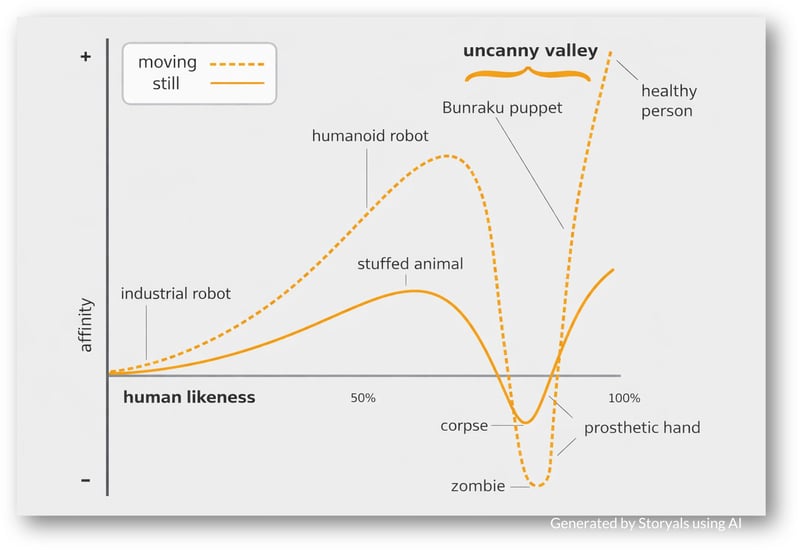
If you’ve ever felt a bit unsettled when technology behaves a little too much like a person, you’re not alone. At Storyals, some of our team members were surprised when the Microsoft Copilot Facilitator agent suddenly appeared in our weekly meetings. This reaction reflects a psychological concept called the uncanny valley, introduced by Japanese roboticist Masahiro Mori in the 1970s. He noticed that as machines look or behave more human-like, our comfort increases - until the point where they become almost human. Then our comfort suddenly drops into a “valley” of unease. Mori also observed that movement intensifies the effect - an unnatural blink or stiff gesture can make a robot feel more unsettling.
In a recent meeting, some of the team members at Storyals had a look at the newly launched humanoid home robot “Neo,” from 1X - and “freaky” was a joint consensus.

It’s important to note that the uncanny valley concept doesn’t only apply to physical robots. AI agents that write like colleagues, facilitate meetings, or make decisions on our behalf can trigger similar reactions - especially when they feel almost, but not entirely, human.
Why people feel resistance toward AI agents
While the uncanny valley explains some discomfort, resistance often stems from deeper psychological factors. Three stand out:
1. Fear of loss
Employees may worry about losing competence, autonomy, or professional identity - especially when AI takes on tasks once linked to human expertise. It’s normal that we get a bit freaked out and fear the loss of our jobs! “What will you need me for now?” was Storyals’ Marketing Manager’s reaction when she saw a marketing plan created by the Researcher agent.
2. Uncertainty about expectations
People hesitate when they’re unsure what AI agents will do, what they remain responsible for, or how their workflows will change. For example, how will the role of the Project Manager be impacted when your organization starts using the Project Manager agent in Planner?
3. Trust that must be earned
AI systems can feel unpredictable and unreliable. Trust grows through clarity, transparency, and real experience - not through technology rollouts alone. Simply purchasing Microsoft 365 Copilot licenses and enabling agents won’t deliver the desired outcomes. Trust for AI agents must be earned.
Recognizing these human instincts will help you as a leader design adoption strategies that reduce fear rather than amplify it.
Recommendations for overcoming resistance
To unlock the full value of AI agents, organizations need more than technology - they need a thoughtful, human-centered approach. Here are some recommendations to follow:
 Create psychological safety
Be clear about why AI agents are being introduced and what they will and won’t do. Emphasize that human judgment, creativity, empathy, and experience remain essential, even as AI automates routine tasks. Be clear in your communication and avoid vague reassurances like “AI won’t replace anyone” if that’s not certain. Instead, communicate specifics, for example, “We are deploying an agent to handle routine support tickets so that our support staff can focus on complex customer issues and relationship-building.”
Build trust through hands-on experience and guidance
Provide employees with low-risk opportunities to test AI agents in real-world scenarios. In our Storyals’ training sessions, confidence grows quickly when people see the benefits for themselves. Don’t just turn on AI agents without offering guidance, recommended use cases, and clear expectations of how agents are to be used. Structure and “know-how” reduce uncertainty and help employees know where to start.
Encourage a growth mindset
Model curiosity and share your own learnings. This helps shift thinking from “Will this replace me?” to “How can this support me?” Invite feedback early on. Resistance often means people care. Involving them in shaping how AI agents are used can transform skepticism into advocacy. Encourage a growth mindset and emphasize that this is a shared journey we are all on together!
As you move forward with your AI adoption journey, remember that continued learning and support are key to lasting success. Storyals Training Programs offer practical, hands-on guidance for end users and full-day workshops on getting started with agents. Please reach out to us at hello@storyals.com or via any of our social channels to learn more.